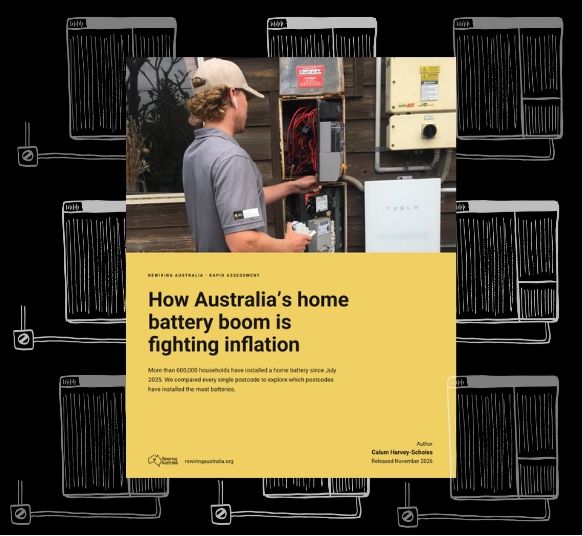
How Australia’s home battery boom is fighting inflation
How home batteries are helping everyday Australians
homes have installed a battery since July 2025
of them are in postcodes with a median household income between $60,000 and $120,000
lower average wholesale electricity price in 2026 so far, compared with 2025
Footnote: Based on our analysis of every Australian postcode

Key insights
Not just the wealthy
Batteries have gone in right across the income range, with only a slight tilt towards higher earners.
An outer-suburban story
The fastest uptake is in growth suburbs like Marsden Park, Narre Warren and The Ponds, not the inner city.
Home Battery Scheme
$500,000 a year: The Cheaper Home Batteries Scheme’s forecast annual cost from now until 2030.
Fuel tax refunds
Last year, BHP alone received more than $600 million in Diesel subsidy, which could be redirected to help households
Home batteries in the outer suburbs are fighting inflation
More than 600,000 households have installed a home battery since July 2025. We compared every single postcode to explore which postcodes have installed the most batteries.
We found that:
- Batteries are being installed by all income levels, mostly in outer suburban growth areas such as Werribee (Melbourne), Marsden Park (Sydney) and Rochedale (Brisbane).
- These home batteries are helping reduce electricity prices and fight inflation. This anti-inflationary power could be enhanced further by incentivising homes to join virtual power plants.
- Rather than attacking this effective anti-inflationary program, we should cut corporate tax credits and redirect those funds to help households.
About this research
Report downloads
Related readings
Home batteries in the outer suburbs are fighting inflation
All income levels have installed batteries
Higher income households have installed slightly more batteries than lower income households, but 81% of batteries have been installed in postcodes with a median income between $60,000 and $120,000 a year. Broadly, the distribution of batteries across income bands appears to be fairly even: the blue and yellow bars in the chart below are extremely similar.
Home batteries are an outer-suburban phenomenon
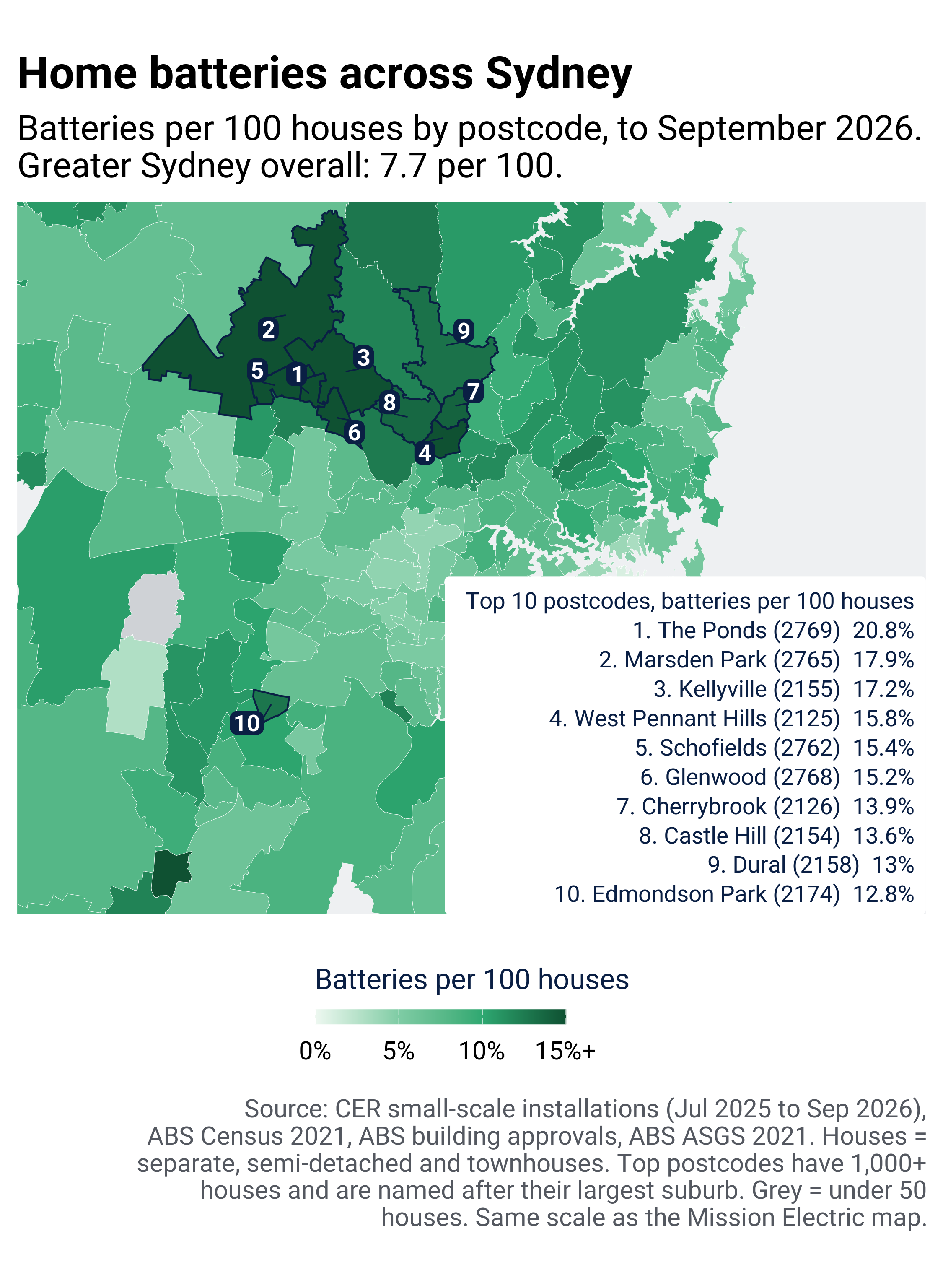
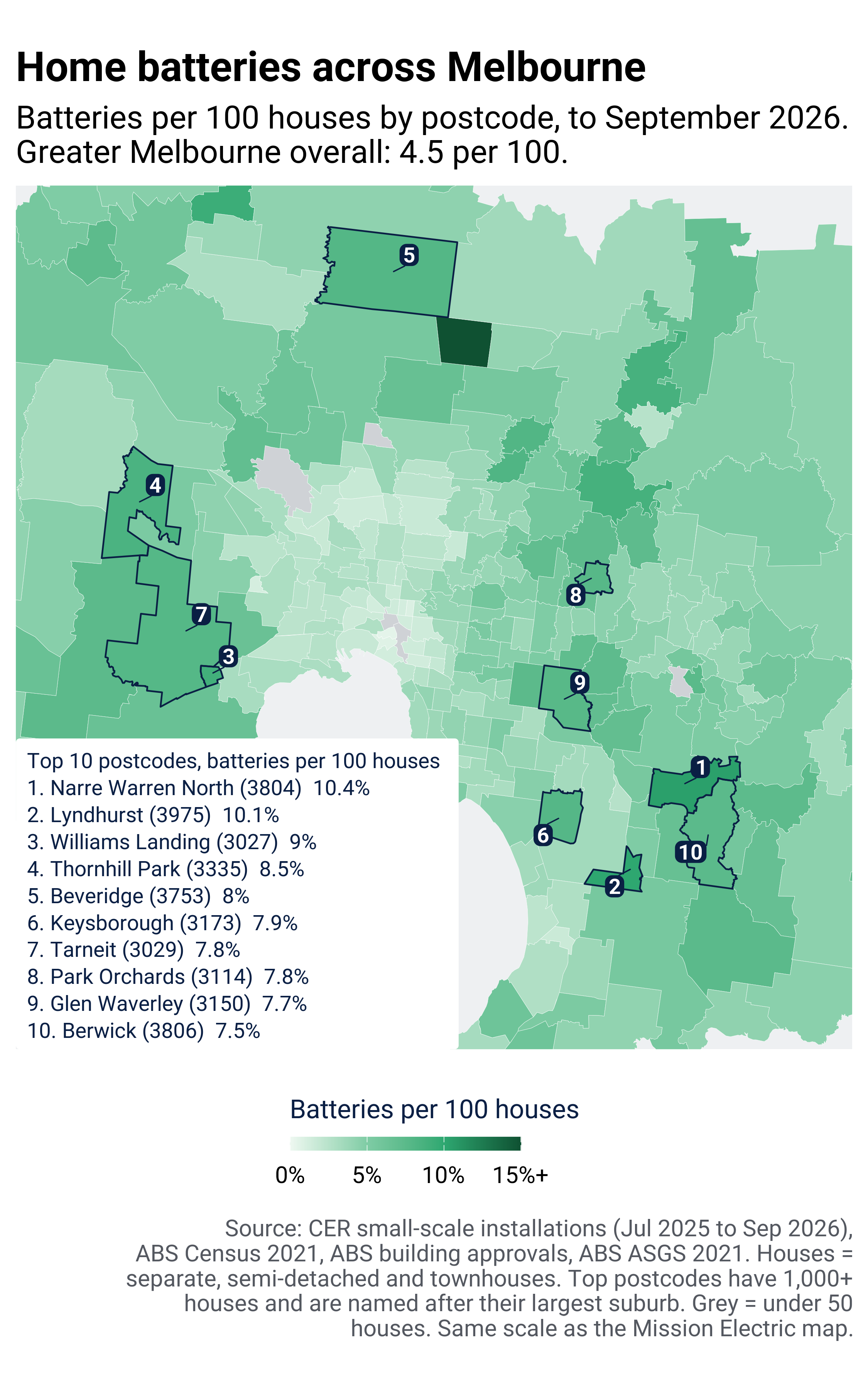
When we look geographically, we see that it is the outer suburbs of large cities where home batteries have been adopted fastest. The highest rates of battery adoption in Melbourne are in fringe suburbs like Narre Warren, Lyndhurst and Glen Waverley. Sydney’s outer west has seen the fastest battery uptake in places like the Ponds, Marsden Park and Kellyville.
Batteries are pushing down power prices and cutting inflation
Large grid batteries and home batteries are both acting to reduce wholesale power prices in the National Electricity Market. Batteries are pushing both gas and coal off the system and putting downward pressure on the price of electricity. This is having a positive impact by reducing inflation.
Petrol has driven inflation in transport and other parts of the economy this year. However, the rapid rollout of batteries, helped by the Cheaper Home Batteries Program, has reduced the use of expensive gas and coal and meant that the wholesale price of electricity has fallen in 2026, reducing inflation. Compared to July 2025, wholesale electricity prices were down around 45% in September 2026. So far, 2026 has seen average electricity prices 30% lower than 2025 as a whole.
Virtual Power Plants
Virtual power plants (VPPs) are a way for home batteries to deliver power back to the grid when it is most needed, in return for payment. Leveraging the flexibility of home batteries to discharge into our homes or the grid on demand is an important way to reduce power prices by avoiding the need to use expensive gas.
Our research earlier this year found that a minority (less than a third) of home battery owners are signing up to these plans. In part this is because VPP operators need to do more to earn the trust of home battery owners, but incentivising households to participate would also increase the public value of these batteries. VPPs respond to price spikes and are a way to further help reduce the price of electricity.
Our Policy Recommendation:
Billion dollar corporate subsidies could be redirected to help households
While families are paying high petrol prices and dreading a potential sixth interest rate hike this year, large mining and fossil fuel corporations enjoy a 100% refund on the diesel duty, and they use a lot of diesel. Fuel Tax Credits are Australia’s largest fossil fuel subsidy, costing us almost $11 billion in the last financial year. Almost half of this goes directly to the mining industry and effectively incentivises increasing use of fossil fuels, heightening Australia’s exposure to foreign oil price shocks.
The roughly $500 million for home batteries could be covered ten times over by the fuel duty refunds handed to mining corporations each year. Last year, BHP alone received more than $600 million in fuel tax refunds, enough to incentivise more than 350,000 household batteries at the current rate.
FAQs
Straight answers to the questions battery owners asked us most often.
No. Based on our postcode analysis, batteries have been installed relatively evenly across income levels. 81% of home batteries have been installed in postcodes where the median household income is between $60k and $120k.
The outer suburbs of major Australian cities are seeing the fastest uptake of home batteries. In particular, suburbs with lots of recent housing development, where there are a lot of freestanding homes, and where most households are owner occupiers, rather than renting.
Lower power bills. Reducing energy bills was the most common motivation given by battery owners in Rewiring Australia's survey of 597 Australians, conducted from 11 May to 4 June 2026. Respondents also cited fighting climate change, using more of their own solar generation, and staying powered through blackouts.
Home batteries store cheap rooftop solar power for the evening and avoid the need to use expensive gas and coal. Large grid batteries are also helping to push gas and coal off the system.
Home batteries which respond flexibly to the grid help to reduce prices for everyone, not just the house where they are installed. This means charging up when it is sunny and discharging in the early evening. Virtual power plants (VPPs) are one way to automate this through a third party provider and be paid for discharging.
A virtual power plant pools many home batteries into one resource. The operator can charge or discharge them to support the grid. Owners typically receive a payment or discount for participating.
In 2025-26, Australia spent $11 billion subsidising diesel through the Fuel Tax Credits scheme. Around half of this was given to mining companies. BHP alone received more than $600 million last year.
Still have questions?
Get in touch