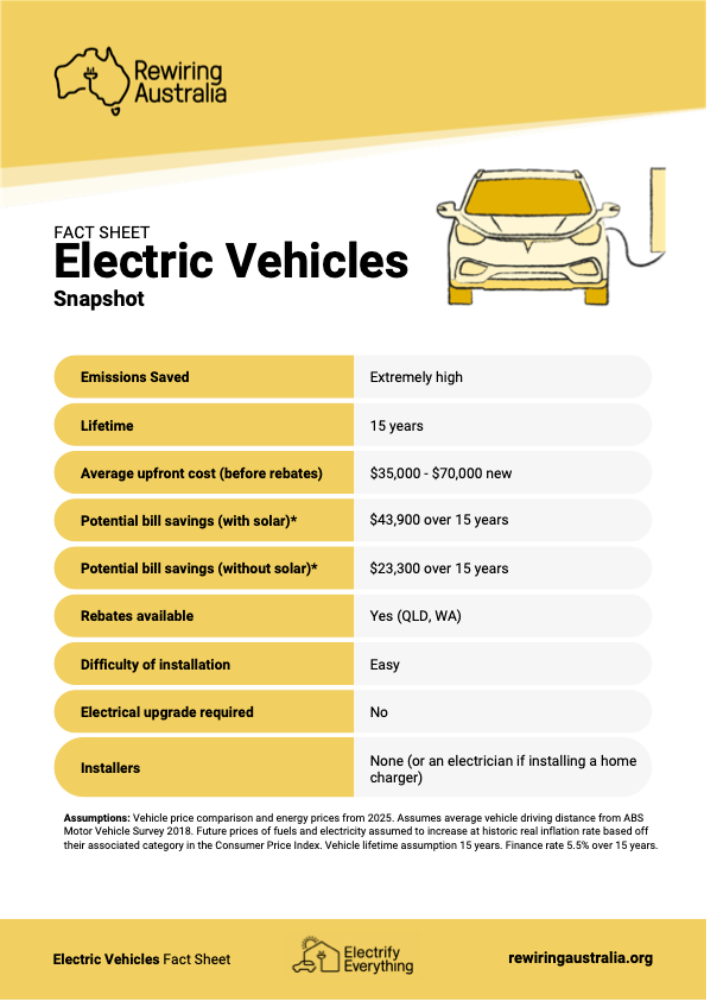
.png)
With petrol prices hitting record highs and cost of living squeezing families across Australia, there's a solution that could save you thousands of dollars a year. It's thanks to the energy we make on over four million Australian rooftops from solar - and it can power your home and your car.
Interest in electric vehicles is soaring. The questions are everywhere. Here's our independent guide to making the switch in 2026.
A few pathways are opening up:
Of course, electric cars aren’t the only way to save on transport thanks to electricity. More families are doing the school run on electric cargo bikes, more riders are enjoying the smooth corners on electric motorbikes, and our trains, trams and even lots of buses are using Australian-made electricity too! It will take a while to switch over our car fleet, and in the meantime there’s lots of ways to cut bills and emissions.
There are three main ways to charge:
The ‘average’ Australian drives 200km a week - that’s usually a mix of lots of short trips or commutes to work, and the occasional road trip. For the vast majority of drivers, plugging in at home to ‘top up’ ends up being 95% of the charging load.
Almost certainly. A standard 7kW smart charger works with most Australian switchboards. Your electrician can confirm, but upgrades are rarely needed.
Modern 2026 EVs comfortably exceed 400km on a charge. That's Sydney to Canberra with power to spare. But the new Tesla Model 3 RWD can do 750km - a sign of what is to come.
One interesting thing about EVs is they use less energy in city traffic than doing high speeds on the freeway - the opposite of what we’re used to in petrol cars. When you’re stopping and starting all the time, EVs automatically recharge the battery using your braking energy. (This also means you don’t really wear out your brake pads either!) But on the highway at 110km/h, wind resistance means range drops by 15–25% compared to city driving.
You’re still saving big dollars even on those trips, but good to know.
The electric ute market is arriving. The KGM Musso EV (around $60k) offers 380–420km range and 1,800kg towing. Models from Geely, LDV, Isuzu, and Kia are on the way. Plug-in hybrid utes like the BYD Shark 6 bridge the gap if you need diesel-matching tow capacity right now.
This segment is moving fast - check back regularly or sign up to our newsletter for updates.
Real-world data shows modern EV batteries degrade only about 1-2% per year. After 10 years, most EVs still retain 80–90% of their original range. Many manufacturers warrant batteries for 8 years or 160,000km.
If you can, go straight to a full EV. Hybrids still burn fuel, still produce emissions, and come with more moving parts and higher maintenance costs. They perhaps made sense as a stepping stone five years ago - but in 2026, EVs are the clear choice, with better range, more choices, more charging infrastructure, and lower prices.
Sign up to our newsletter to stay across all things EVs and learn how you can beat the cost of living crunch by going electric.
Use our calculator to find out exactly how much your household could save on energy bills by going electric.