.png)
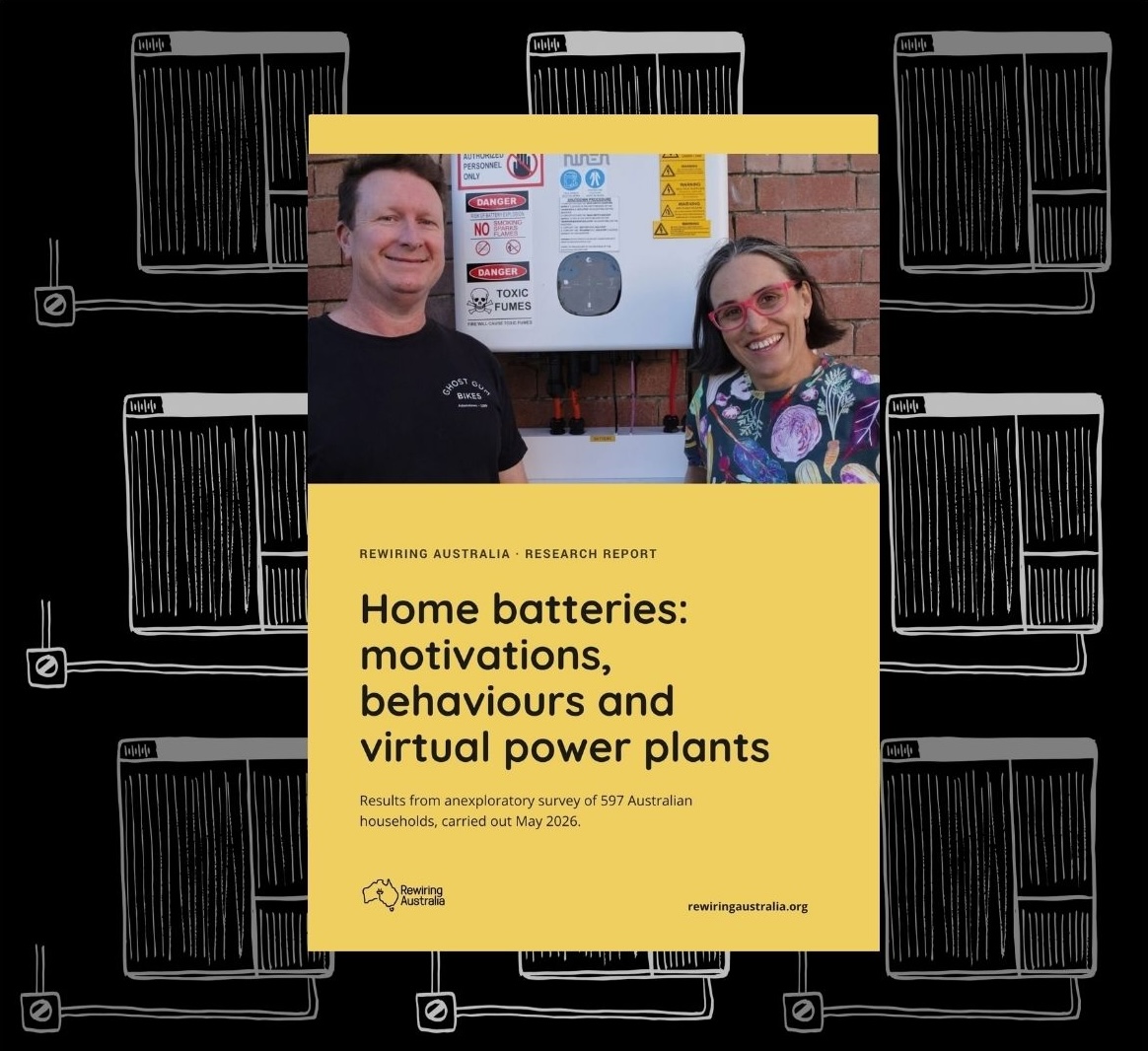
Home batteries: motivations, behaviours and virtual power plants
Out of all 597 people across Australia included in the survey:
of those without a battery were interested in one
of battery owners have not joined a virtual power plant
home batteries are soaking up daytime solar in Australia
Key insights
Cost
The leading barrier to getting a battery is the cost and payback.
Lowering bills
The leading reason for getting a battery is to lower bills
Satisfied
The vast majority of owners are satisfied with their battery.
It's boomtime for home batteries in Australia.
Every week from July 2025 to June 2026, more than 800 Australian households have installed a home battery. Across the country, more than 500,000 home batteries are now soaking up daytime solar, saving it for the evening when they discharge to power our homes and neighbourhoods. This rollout is the fastest transformation our local electricity networks have ever experienced - outpacing the solar revolution 15 years ago. However, only a minority are signing up for Virtual Power Plants which offer a way to coordinate this distributed energy and pay battery owners for the occasional use of their battery.
In May 2026, Rewiring Australia carried out a survey of battery owners to understand what is motivating people to install batteries and how they are using them. More than 597 people responded from organic communications. Methodologically, this was an exploratory study, not rigorous representative polling; respondents to the survey were self-selecting, responding to broad outreach via email and social media.
This report summarises the responses to a survey carried out from 11 May to 4 June 2026.
About this research
Report downloads
Related readings
What did 597 Australians tell us?
Respondents by household income
Respondents mostly live in freestanding houses (89%) which they own (98%). They span all age brackets and income levels but are concentrated among the older and more affluent brackets.
Why are people buying batteries?
Those without a battery reported concerns about the cost and whether getting a battery was worth it as the main barriers to getting one.
Why some respondents are not interested in a battery
Lower energy bills are the most common motivation for buying a battery. Respondents also cited fighting climate change, using more of their own solar power and avoiding blackouts.
Read the full report:
Battery owners told us they had installed a battery to reduce their bills and fight climate change. Most of those without a battery were interested in getting one, and the biggest barrier to getting a battery is the cost.
Your Home Battery Could Do More Than Power Your Home
More than 400 Australians shared their experiences owning and using a home battery.We found that battery owners are overwhelmingly satisfied with their systems. But our research also highlighted a major opportunity - how we can unlock more of the value that home batteries can provide to the grid.
FAQs
Straight answers to the questions battery owners asked us most often.
Three in four. 75% of respondents who did not have a home battery said they were interested in getting one, in Rewiring Australia's survey of 597 Australians conducted from 11 May to 4 June 2026. Cost was the main thing holding them back.
Cost, and uncertainty about payback. Among respondents without a battery in Rewiring Australia's May 2026 survey, the upfront price and doubt about whether the investment would pay for itself were the leading barriers.
Lower power bills. Reducing energy bills was the most common motivation given by battery owners in Rewiring Australia's survey of 597 Australians, conducted from 11 May to 4 June 2026. Respondents also cited fighting climate change, using more of their own solar generation, and staying powered through blackouts.
Mostly outright homeowners in detached housing. 89% of respondents lived in freestanding houses and 98% owned their home, in Rewiring Australia's survey of 597 Australians run from 11 May to 4 June 2026. Respondents spanned every age and income bracket but clustered in older, higher-income groups. The sample was self-selecting, so this describes engaged battery owners rather than all Australian households.
Overwhelmingly, yes. The vast majority of battery owners in Rewiring Australia's May 2026 survey reported being satisfied with their battery. Many owners also reported that doing lots of research beforehand meant that they were happy with the result. Tools such as electricsaul.com can help with some of this research.
A home battery is the hardware on your wall or in your garage. A virtual power plant is a service you can connect it to, which lets an operator charge or discharge it alongside thousands of others to support the grid. Every VPP participant owns a battery, but seven in ten Australian battery owners surveyed by Rewiring Australia in May 2026 were not in a VPP.
Flexibility keeps electricity available when people need it: absorbing surplus solar in the middle of the day and supplying power when demand peaks in the evening. Improving flexibility in this way can help to increase the use of cheap solar power and reduce energy costs for everyone, not just those with batteries. Using home batteries to provide flexibility can offer more value to battery owners and reduce energy bills even further. With more than 500,000 home batteries installed across Australia, coordinating them has become a national-scale opportunity.
Still have questions?
Get in touch