.png)
Every Australian state and territory has agreed to work with the Commonwealth to legalise “plug-in” solar and batteries. While the details still have to be worked out, with more coming by the end of the year, this commitment is a big step forward to giving renters and strata households more control of their energy bills
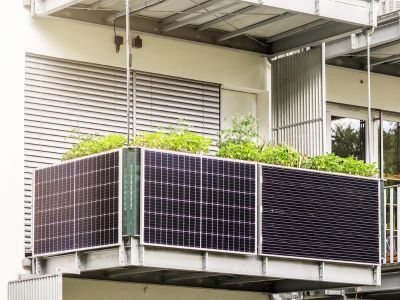
On Friday, federal Climate Change and Energy Minister Chris Bowen announced that every state and territory energy minister had agreed to work together to enable the safe use of plug-in solar and batteries, sometimes known as balcony solar, in homes across Australia. Ministers will report back on concrete next steps before the end of the year.
Plug-in solar and batteries can be bought from a shop and simply plugged into a ordinary wall socket by a resident - no need for an electrician. They are also known as 'balcony solar' as the panels can be hung from the railings of an apartment's balcony.
Only around 6 per cent of Australian apartments and 11 per cent of rentals have solar, against nearly 50 per cent of owner-occupied homes. About 30 per cent of Australian households rent. Far fewer renters and apartment dwellers have home batteries.
Most of our rules still assume solar and batteries have to be permanently bolted onto a home you own and installed by an accredited installer. That locks out renters almost entirely, and it catches apartment owners too, who can own their home outright and still be blocked by a strata committee or a building with no suitable roof.
Plug-in devices change that. In particular, plug-in batteries will be a real unlocker for renters and strata households to help avoid the expensive evening peak power prices.A panel that plugs straight into a normal power point, sometimes paired with a small battery, lets people generate and store their own power for the first time, no matter who owns the roof, and take it with them when they move.
Two plug-in panels on a Brisbane balcony, about 20kg each, generate roughly 800kWh a year. That runs a fridge and a washing machine and saves a typical family around $200 a year. Even without solar, a plug-in battery paired with a Solar Sharer plan, which gives many Australians three hours of free electricity a day, enables households to charge up for nothing at midday, then run the house off the battery through the evening peak.
More than one million balcony solar systems are registered and operating in Germany, where supermarkets sell a two-panel 800 watt kit for around 200 to 300 euros. A new international white paper from Germany's Bundesverband Steckersolar and Anker shows adoption accelerating across Europe and the United States. The UK legalised the technology last month. New Zealand has signalled it will follow within a year.
Australia leads the world on rooftop solar and gets more sun than any of them. Our regulations are the thing holding us back.
The safety work is happening here too. Glen Morris, a member of the Solar Standards Committee and Director of the Smart Energy Lab, is running trials in the Yarra Valley alongside the CSIRO, testing how plug-in systems interact with Australian certified inverters, anti-islanding protections and network requirements.
"There really is no technical reason why Australians should not be able to safely access balcony solar but the regulatory framework needs to catch up fast."
Glen Morris, Solar Standards Committee and Smart Energy Lab
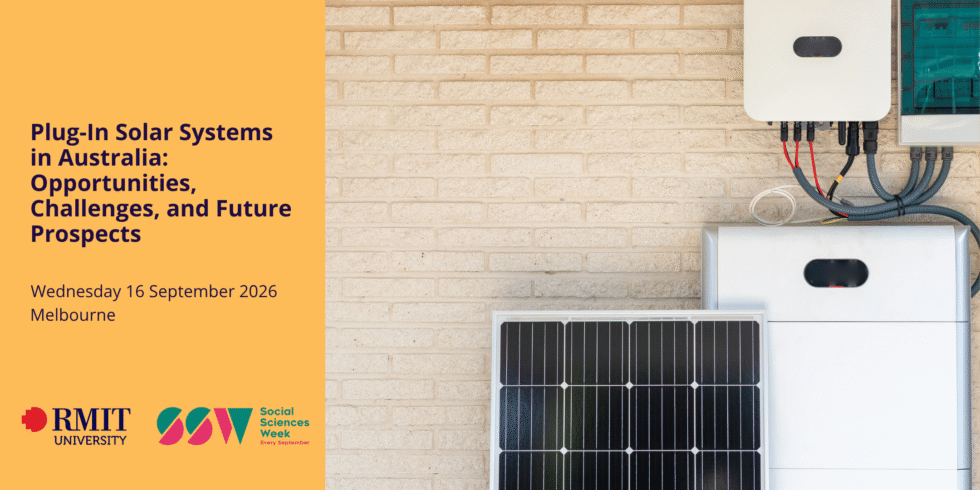
Glen is picking this up on Wednesday alongside our Head of Research, Calum Harvey-Scholes, on an RMIT panel for Social Sciences Week, with Associate Professor Nicola Willand of RMIT. They will work through the regulations, the safety standards, consumer acceptance and the protections renters and apartment residents need.
Plug-in solar systems in Australia: opportunities, challenges and future prospects
This didn't happen by accident. Rewiring Australia has spent the last two years working to make this moment possible: meeting with energy ministers and their departments, with researchers, with energy sector representatives in Germany and the UK, and with technology providers.
Much of that work is public, and it is worth reading if you want to know what comes next.
"Rooftop solar gave millions of Australians control over their energy bills. Portable energy is the next step, extending that choice to people who do not own a suitable roof."
"The next generation of clean energy technology needs to be portable. People should be able to own their energy assets and take them with them when they move."
Francis Vierboom, Chief Executive Officer, Rewiring Australia
Plug-in systems are still not permitted to be connected in Australia today. When ministers report back before the end of the year, that report needs to contain a 12-month roadmap to give Australians the right to plug in.
Alongside our industry and standards partners, we are calling on state and federal energy ministers to:
Follow us to stay updated on this process and how you can get involved.
Electrifying our homes and cars is the recipe to cut emissions and save money for Australian homes. Let's build an abundant electric future for Australia.
“Electric technologies are scientifically proven to be cheaper and more efficient. A heat pump water heater or reverse cycle A/C uses around a quarter of the energy to heat the same water or air. Gas goons will never tell you this and say it’s about consumer choice. It’s imperative that nobody is fooled by their lies.”

Join this webinar organised by the Nature Conservation Council to hear from experts on how improving energy efficiency helps fight climate change and why a Healthy Homes Plan will support rental homes (which are 1/3 of homes in NSW) to be more affordable and liveable.
South Australian gas customers risk being left with millions of dollars in new connection costs after the Malinauskas Government quietly delayed a national rule taking effect today that would have made new gas connections pay their own way.